
I want to go home and to pull into the drive and see my mum busy in the kitchen cooking tea. I want the kitchen to smell of baking and cooking. I want her to welcome me with a hug. I want to help her finish tea while chatting about what I’m up to and what she’s doing at work. I want to sit down with my family and eat with them. Then after I want to go and sit in the lounge with all of them, with mum, and watch tv or a film or something (but spend so much time talking over it that we hardly know what’s going on). And I want my Mum to offer me chocolate and offer me 1000 reasons why chocolate is 100% necessary for human survival. And I want to be able to put my head in her lap or sit on her knee when things get hard. And to take selfies with her. I want to hear her laugh. I want to be able to go into her bed at night again when things get too unbearable and I’m not sure I can make it as far as morning. I want her to ask but not expect an answer and just be there. I just want somewhere to feel like home.
All
6 Months
It’s 6 months today since Mum died. There aren’t really any words to put to it. It’s just a fact.
A lot has changed in the past 6 months. I live somewhere new, I’ve made new friends, I’ve lost a few friends, I stopped going to uni and started volunteering at a few places and doing a course at Mind, I started a new job, and I’m slowly trying to develop some sort of a social life.
There have been some great things and some not-so-great things.
I thought maybe I’d start to miss Mum a little less, but at the moment I seem to be missing her more and more. I’m not sure why, perhaps it’s the weather, who knows. 6 months-post death and people stop asking. Not a criticism on anyone, life moves on, people move on, and there’s not a lot you can update when it comes to grief (as opposed to illness where something happens all the time). Sometimes I just want a Mum hug though, they’re different to other hugs. It can feel like all I need is one hug and I’ll be on my way. I didn’t live with Mum in her final years so it’s not like I saw her every day, but we did text often and I knew where she was if I needed her – I suppose I always took that for granted. She wasn’t meant to die.
So 6 months have passed. Soon there will be another 6 months, and then another. I just hope that with each passing 6 months, things get a little easier.
Illness vs Death
People don’t realise that has horrible as Mum dying was, it’s her illness which is having such a huge effect on me at the moment.
It was seeing her slurring and seeing things on the walls, unable to eat or walk, and then getting lost in Leeds in the dark on a Friday night because I was so upset I didn’t look where I was going and before I knew it I was stuck somewhere not-so-safe. Before that I was so confident at being out and about but now if I’m out in the dark I am so anxious and it’s only made worse by noise.
It was seeing the woman I’ve always seen as so strong, capable and ‘big’ unable to even reach up to her face to scratch her cheek… having to feed her water through a sponge and wipe her face for her. Then seeing other women, who I’ve always seen as role models, crying. Leaving the room and crying. Turning away and crying. Breaking down unable to speak. Having to remain strong for them, because they needed it.
The last stages of her illness were hard, really hard… but it was the sudden deterioration 8 months prior to that which really changed everything. It was so sudden and so unexpected.
I miss my Mum a huge amount, and there is a lot to come to terms with, but it’s the illness I’m struggling to get past. I get images in my head and I can see them in front of me when I’m watching TV or walking in the street or whatever and they won’t go away. Sometimes it feels like I’m back there. I haven’t slept in my bedroom at Dad’s house since that week.
I don’t know how to deal with it or where to go with it. There are no answers or solutions. I don’t even remember it all properly (yet?) but it’s just always there.
 It was seeing the woman I’ve always seen as so strong, capable and ‘big’ unable to even reach up to her face to scratch her cheek…
Spotting the Gap
Today I went to the Central Leeds Children and Young People’s Mental Health and Wellbeing Event. It’s a very long name but was essentially a day in a room with a bunch of lovely people from around Yorkshire discussing children and young people’s mental health and the barrier to them accessing care. It was interesting and there were some (hopefully!) useful discussions. There were a lot of commissioners there too who seemed to want to listen to what young people were saying, so that’s always positive.
Halfway through the day we were left to our own devices to network. I met some lovely ladies from the charity ‘Just B‘. Just B are based in Harrogate and part of St Michael’s Hospice. They work with children and young people both before and after bereavement, and with adults post-bereavement (whether the bereavement itself was linked to the hospice or not). I had heard of them before but didn’t know a lot about them and certainly didn’t know they were linked to the hospice.
After we’d been speaking a little while, I brought up Mum (she often comes up in conversation, it usually goes something along the lines of ‘oh you live in York, are you at uni?’ ‘no, I was though’, ‘oh right did you graduate? what did you study?’ at which point I promptly forget that cancer/death/mum might make people feel uncomfortable and proceed to either have a great conversation, or a mini counselling session, or a mini counselling-someone-else session, or a very awkward end to a conversation and we all move on). Today it resulted in a great conversation.
I spoke to them about the gap in bereavement and terminal illness support for ‘young adults’. When you’re under 18 and there is a terminal illness in the family, the school, or a local charity often steps in and offers support. When you’re a ‘proper adult’, there is normally a friend who has been through something similar and can offer a shoulder. You’re also more likely to be settled somewhere and possibly have a job. When you’re over 18 but not really an adult, your friends are stumped, if you’re at uni they feel a bit stuck because it’s not something they often have to deal with, services often feel ‘too old’ and don’t seem to understand the complexity of being in your twenties (where you still really need your parents and more often than not are not settled in a stable living place and/or stable job). Young Adult Carers are available in some areas and they are absolutely brilliant, but there’s definitely a difference between having a chronically ill relative and a terminally ill relative.
At some point during this conversation, a commissioner came over and shared her story about her Mum dying at a young age.
The two ladies I spoke to were lovely and commented that until I mentioned it, they’d never thought of/seen that gap. They did say that they could completely see it, though, and that they had services available for that age (as they deal with both children and adults), but it just wasn’t something that they’d ever really seen as being a gap.
I shared my details with them (they might even be reading this post, I don’t know!), but it just hit home to me again that this gap is there and that there isn’t an easy solution for plugging it. Services aren’t often there, and even when they are there they aren’t necessarily ‘marketed’ to 18-30s. Grief is a personal thing at any age, but it’s definitely different to grieve for a parent at 21 compared to at 51.
It’s something I really want to look at. I want to create a space for people in a similar situation to myself (and Jenny, and Laura if you haven’t checked out their blogs you should!) to share their stories. To rant, to moan, to smile, to laugh, to get angry, to breathe and to ask advice. I want to find other young people in this situation and let them know that they are not alone and that life without their parent (or other close relative) can still be a life, even if it looks a bit different to how they imagined it would be. I want to share hope. There are lots of days when I feel hopeless, useless, angry, scared, lonely, happy, pretty much every emotion under the sun (frequently all of these in the space of 30 seconds), and I need people to know that it’s okay for that to happen.
It can be so lonely having a parent who’s ill and it can be so lonely having a parent who’s died. It’s hard to know if you’re making the right decisions (something I’ve often written about in this blog), when no decision seems like the ‘right’ one. It’s so hard to build your life back up when the world as you know it has changed forever. I’m lucky that I have some really good friends, but the mean age of my friends has probably gone up about ten or twenty years since Mum was diagnosed, and I’ve lost a fair number of friends along the way – and it’s not their fault or my fault, it just is.
I’m rambling now (and my brother isn’t editing this blog so apologies in advance!), but I can just see this gap glaring at me, and I don’t know how to fill it. I don’t even know how to make people realise it exists. But I want to, and I suppose the first step of anything is wanting to do it.
The Great Grief Identity Crisis

I’m having a bit of an identity crisis. I’ve always defined myself by what I do, or how I relate to others, but it all seems to be a bit mixed up right now.
I’m not at uni, so I’m not a student. I am working, so I am employed, but only one day a week, so that always leads to questions about what I do with the other six days… I am a daughter, though one without a Mum. I am a niece, sister, cousin and granddaughter, but none of these are really talking points.
People keep telling me I’m like Mum. That they can see Mum in me; in my looks, my personality, my values. But I am not Mum. I am not and never will be Mum. I do not have the same ambitions as Mum had. I do not have the same desire to be surrounded by people that Mum had. I do not have the same level of intelligence that Mum had.
Mum was incredible at her job. She achieved a huge amount in her career including developing a department in the hospital, working with Marie Curie, contributing to several publications, doing some bits and bobs down in London to advise panels about her job from a national standpoint, and being a trustee at the local children’s hospice. She was a well-known figure in palliative medicine and well-liked by colleagues. Every time I ‘Google’ her career, something else comes up. When she wasn’t working, she was active in the community and the church.
I doubt I will ever have a career as successful as Mum’s. I doubt I will ever make as much of a difference in people’s lives as she did. I don’t have the single-minded ambition that she held and don’t have the same love of academia that she did. I like to be doing things, practical things, on my feet and out and about.
Mum’s illness caused me to lose bits of my identity. Her illness resulted in my time being split between uni work and heading back to visit my family. The more ill she got, the more any ‘free’ time disappeared, and with that any ‘me’ time, any time to follow non-academic pursuits and any time to pick up hobbies. Life became uni-Mum-sleep-uni-Mum-sleep very quickly and in all that I lost myself a bit.
Building my life back up is hard… really hard. I’m having to rebuild myself, almost – or make a new self – but I don’t really know who it is I want to make, so I’m sort of blindly following things that come up and cobbling together some sort of life, whilst also attempting to deal with grief for Mum and my old life. Mum always said she just wanted me to be happy, but it’s hard to be happy when every day is another day she’s not there to talk to. I don’t know who I’m making, I don’t know who I am or who I will be next week.
I don’t want to live my life as “Fiona’s daughter”. There are a few people I know at the moment who think of me this way, and it feels like such a burden. It also doesn’t do justice either to me or to Mum. Mum wasn’t just a mother: she was so much more than that. And I may be her daughter, but I am so much more than that, too. The values that both Mum and Dad instilled in all three of us lay the groundwork for us to build our lives on. I only hope that, in time, I can start to use these things – the wisdom, advice, baking skills, work ethic, and countless other things about them that inspire me – to build myself into someone very different to Mum, but hopefully someone they’re proud of.
Featured: http://www.huffingtonpost.co.uk/naomibarrow/grief-identity-crisis_b_9629476.html
Who am I writing for?
I’ve been struggling for inspiration these past few weeks.
I used to just sit down and write. While Mum was ill lots of things were happening so there was always something to write about. Then she died, there was a funeral, there was Christmas… always something to write about. But grief is boring, not a lot happens, it gets quite tedious.
Sometimes I have had inspiration but I’ve felt unable to write about it because it didn’t ‘fit’ with this blog. That inspiration then passes and once again I’m left mute.
I think I all too often forget why I’m writing and who I’m writing for. Initially I would just sit and write – a sort of catharsis – but as time went on and the blog grew, I began to feel more pressure to write ‘well’. Initially this lead to writing each post in word and copying them across (spelling and grammar have never been my strong point), then months ago, I started getting my brother to proof read things for me, and some blogs have more input from him than others.
More recently, though, I feel like I’ve lost my voice. I feel disconnected from my blog. I feel as though it’s run away from me and I’m left behind in the dust and I’m not quite sure how that’s happened. I think I need to stop worrying about what’s ‘right’ or what people want to read, and start just writing again.
Some of My Past Died With Mum
Grief is a strange (and on the whole, very boring) thing. We’re now entering month five of life without Mum and I was beginning to think maybe the surprises were running out. Apparently that’s not the case, though.
After getting in a conversation with someone yesterday and coming home and pondering, I was struck with the realisation that I can’t remember parts of my past. Not only can I not remember things, but I can’t think of anyone who would be able to remember them…
I’m not talking about major life-changing events like ‘which primary school did I go to’ or ‘what GCSEs did I choose’. Thankfully there are records for that. Also, I still have my Dad, and although his memory may not be as good as Mum’s was (which was scarily good), much of my past is still held in his memory.
However, this isn’t a foolproof set-up. When we were younger, my Dad worked away during the week. Mum worked long hours, too – but she saw us each night. There are a lot of the things that happened over that period that I can’t remember, but will have existed in Mum’s memory – and they will have died with Mum. Basic things like ‘what was my favourite badge to work on at Brownies?’ and ‘at what point did I realise English was anything but my favourite subject?’ I will probably never know.
There are other things that Dad will have known at the time but will not remember now. Things like the people I played with at school, my favourite subjects in Year 2, and my favourite item of clothing as a nine-year-old (although if I hunted round the photo archives for long enough, I could probably work that last one out).
These things are only skimming the surface of what I’ve been thinking over, but they are examples of items in my lost past. It’s really hard to explain how it feels to sit there and try and conjure up memories and have nobody there to fill in the blanks. In the past, if I wanted to know something I would just text Mum, but now I can see the memories but can’t reach them to make sense of them, and there is nobody there to help me do that. It’s incredibly frustrating and depending what it is, can be quite distressing.
As well as memories in their purest form, there are many things that I’m sure I remember ‘wrongly’, or remember correctly but with the eyes of a seven-year-old. Sometimes you just want someone else to offer some perspective on your memories, but when only two of you were involved in that memory and one of those people is dead, where does that leave you?
Even ‘taking a trip down memory lane’ is hard. At 18 I visited London with Mum for an awards evening, there are things we did on that trip and if I want to remember them I no longer have anyone to bounce those memories off. I can only remember it on my own. It’s so lonely.
It is really weird knowing that if I lose a memory, and only Mum would have remembered it, it is now a nothing. It’s a gap. I don’t know where it went or what it turned into but it’s not there anymore. It’s been replaced by space and silence. For the rest of my life, that gap will always be a gap; there will never again be a piece of memory that perfectly fits.
Featured: http://www.huffingtonpost.co.uk/naomibarrow/grief-bereavement-memory_b_9507124.html
Motherless Mother’s Day
Mother’s Day is not the easiest days for those people without a mother. There are big signs in every shop shouting at you to buy things for your Mum, giving those of us without Mums daily reminders that we don’t have someone to buy these things for.
Even if you learn to deal  with that and avoid certain shops or just brace yourself every time you visit the supermarket, it doesn’t prevent the harsh wake-up call every time an email pops up on your phone with latest ‘Mother’s Day offers. It’s become such a commercialised event that it really is everywhere.
The Mother’s Day after Mum was diagnosed the first time, she was just entering remission, so it was great! We got a fruit basket that looked like a bouquet delivered to her work the Friday before. The company we went through were absolutely fantastic, and we were so lucky to be able to get her something a little different as her taste buds had been knocked out by chemo.
Mother’s day 2014, Mum was about a month into diagnosis. We went t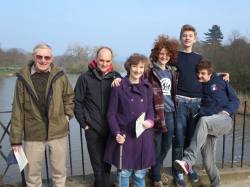 o the Yorkshire Sculpture Park which is a brilliant place to go. My brothers and I climbed over lots of the sculptures, and we played catch with Dad. Mum was a little slower and had started using a stick. She took a slower walk with my granddad and aunt (I imagine my uncle was with them briefly too but he always gets lost…). Playing catch without Mum was my first hint at what life without Mum might be like, but all in all it was a lovely, family, day.
Last year’s Mother’s Day, Mum had just got out of her longest and last hospital stint. She’s deteriorated rapidly a few weeks preceding it and had ended up in a coma where she had remained for a number of days. Everybody thought she would never wake up, but being as stubborn as she was, she did wake up and in the following weeks she slowly began to get back on her feet with the help of her trusty zimmer frame (which I dutifully yarn bombed on her arrival back home).
A few weeks ago, when Mother’s Day began to enter the shops, I spoke to a few people about how they dealt with the whole ‘motherless Mother’s Day’ thing. There were a number of suggestions including lighting a candle at home or church, visiting their Mum’s grave or the place her ashes were spread, spending time with children or grandparents, or simply having a moment at home remembering the good times they shared.
One suggestion was to have a place online where people could share memories with their Mum. For me, one of the harder parts of Mother’s Day, is seeing things Mum would have loved and having nobody to buy them for. So, combining those two ideas, I contacted Yorkshire Cancer Research, the charity who Mum requested donations be sent to at her funeral.They helped develop a drug called Tamoxifen, among other things, which Mum took during her remission which gave us some more time with her. With their help, I have set up a page, which can be found here. The idea is that people can come and donate the amount they would have spent on a card for their Mum, and share a memory about the times they shared together.
It’s not the same as having a Mum to buy things for, and it doesn’t take away the pain of grief, but hopefully, it will help to raise some money for Yorkshire Cancer Research, which could prevent future sons and daughters from experiencing as many motherless Mother’s Days.
Marie Claire Article: My Life Was Perfect… Then My Mum Died
My life has always been set out in front of me. Nursery, primary school, secondary school, possible gap year, uni, have a job, get married, produce 2.5 children and buy some pets, then watch my children go through the same system I did while I excel in my job, bake cookies on weekends, and skip off into the sunset. A nice, neat, perfect little life.
I imagine that anyone else who has grown up in a middle class family will have had similar expectations. I know many people at my secondary school had a similar life plan – lots of students achieved 11 A*s at GCSE followed by 3 A*s at A-Level. BTechs weren’t even taught and the advice was generally to study the ‘better’ subjects; sciences and maths, avoiding the ‘doss’ subjects like Art or Product Design. Following a gap year, I trotted down the uni path like everyone else.
That was where things went a little ‘off-piste’. During my first year, my Mum was diagnosed with terminal cancer. Even though Mum was ill and I visited her in hospital and things, I carried on with my studies. The amount of pressure I felt to carry on as ‘normal’ was immense. The pressure didn’t come from anyone else – everyone completely understood that things wouldn’t be ‘normal’. Instead, the pressure came from myself. I needed to fulfil the perfect blueprint that I’d always believed defined success.
With second year complete, I hobbled into third year. Mum was ill. She was dying. But little old me needed to fill this mould, so I continued to head to lectures when I could. My attendance was more sporadic than I’d have liked, and I visited Mum every night, but I kept smiling, kept attempting to read, kept trying to work out what the heck a p-value was and why it was relevant.
Then Mum died. Four days later I walked into a statistics lecture and sat ready to learn. I tried to do the maths whilst replying to texts about funeral arrangements. I was happy and ‘normal’. People commented on how ‘strong’ and ‘brave’ I was. Well done to me, big gold star for completely ignoring grief and pretending to be absolutely fine.
A week or so later, my attendance was occasional at best. People were talking about having a break and postponing graduation. I didn’t know what to do. I needed to ignore everything in my life and follow the rules and the path that have always been set out for me. I had uni telling me to consider time off, my Dad telling me that maybe after the funeral it would all be better – that my dissertation might be a ‘good distraction’. All I wanted was my Mum.
I ended up sat in front of my GP and asked her what to do. She told to take time out. So that’s what I did. I agreed to take a Leave of Absence from October to January, then complete the first term the following year and postpone graduation.
This train to ‘perfect middle class life’ was still heading to the same destination but via a different route. People understood that I needed some time; Dad thought I could work on my dissertation still while I was off, it was all good.
Then it came to coming back, and I still wasn’t ready. I was trying to work out how to live life without my Mum. I was trying to get my head around returning to studying, despite not having the concentration to read even a few pages of a book. I was trying to compute how I’d get to lectures when some days I was struggling to leave my room, or even shower. My support team felt I would do myself a disservice if I returned to uni in January, both in terms of my health and my grades. So that was that, more time out, no uni until October. No lectures, no workshops, no essays to write, none of it.
Fastforward a few months, and the train to ‘perfect middle class life’ is now so far gone I can’t see it. Making the decision not to return was one of the hardest choices I’ve ever had to make. The pressure to be ‘perfect’ and ‘invincible’ is strong.
I feel like I should show the world that cancer took Mum but won’t take me. I feel that I should just ‘get on’ with life and build myself up, bit by bit, to create this ‘perfect’ life that has always been set out for me.
My fear of failure is something I fight against every single day. To look perfect, study perfectly and have the perfect social life. But sometimes, carrying on isn’t brave – breaking that ‘perfect’ mould is. It would have been easy to stay at uni and keep attempting to go to lectures. It would have been easy to cobble together some words and hand in sub-par work. It would have been easy to break myself in order to finish my degree ‘on time’.
Taking leave means that I’ve had to find a new place to live and find something to fill my days with. It means that I’m going to return to new classes with people I don’t know. Perhaps the hardest thing about it, though, is that I have to admit to myself and the world that I’m not okay. That life has got in the way of this path I’ve always thought I had to follow. I have to face up to not just my grief, but also to the effects of seeing Mum’s health slowly decline.
I have to admit I’m not ‘perfect’ and work on myself, and admitting to that is probably one of the hardest and bravest things I have ever had to do.
Read more about Marie Claire’s #BREAKFREE from Fear campaign.
It’s Horrible Feeling Ill, and Worse When You Can’t Even Text Your Mum.

This weekend, I haven’t been all that well. This isn’t unheard of or anything – throughout Mum’s illness, I had a couple of periods where I fell ill. Whether it be a standard bug going round, leaving me bedbound and anti-food for a few days, an exciting late-night A&E trip with an asthma attack, or something else, I’ve become somewhat of an expert at developing odd symptoms over the past couple of years.
Whenever I was ill, I either told Mum afterwards (in the case of something short like an asthma attack), or told her but refused to let her visit. Mum’s immune system was often compromised over the course of her illness; aggressive chemotherapy does that to a person. I made sure never to do anything which could put her at risk of catching something. And even if I was ill with something that wasn’t contagious, I didn’t want to put her through the stress of seeing me ill.
This was so hard. All you want when you’re feeling rubbish is for your Mum to give you a hug and remind you there are better days ahead. To hold you together when it feels like things are falling apart… to stroke your hair, or bring you a drink, and remind you that it won’t last forever.
So keeping Mum away wasn’t ideal, but I would text her to update her on how I was doing. She was generally pretty unsympathetic, actually, unless I actually felt like I was dying (I think it’s probably a symptom of being a palliative medicine consultant). Maybe unsympathetic isn’t the right word, maybe matter-of-fact would be closer to the mark… but she would always reply, usually with kind words, happy thoughts, and often something to make me smile or laugh.
This weekend I’ve pretty much been restricted to my bed with headachey, dizzy, blergh-ness. I’ve felt pretty low in myself; I hate not being able to get out of the house, or even being able to get up and do stuff. I’ve been too exhausted to even go downstairs the majority of the time. Having wifi in bed has been a bit of a lifesaver to be honest because at least I’ve had a bit of contact with the outside world.
On Friday night I started crying because I felt so rubbish and all I wanted was Mum. I’m really lucky to have some amazing women in my life who frequently fill in as ‘stand-in Mum’ when a situation calls for it. But I think being ill is one of those times where you just want your ‘real’ Mum and no-one can fill that role, however amazing they may be and however much they might want to or try to.
I’ve stopped talking about Mum as much generally. I don’t think people want to keep hearing about it, and after a time you run out of things to say or words to explain what you’re going through. There are only so many times you can say ‘I’m hurting and it’s crap’, before even I get bored of hearing myself say it. I’m running out of words and losing the ability to express how I’m feeling, because more often than not I simply don’t know.
I know, though, that when I’m ill, all I want is Mum, and the only thing that sucks more than her not being there in person, is not even having her at the end of the phone.
Featured: http://www.huffingtonpost.co.uk/naomibarrow/feeling-ill-when-you-cant-text-your-mum_b_9241860.html
 Naomi Jane